Why MSP Clients Demand a 'One-Pane of Glass' Portal in 2026
Jennifer Giraldo
Invarosoft Team
Here's a question worth sitting with: if your clients can track a pizza delivery in real time, why should they tolerate calling a helpdesk just to find out the status of a critical IT ticket?
The answer, of course, is that they shouldn't. And increasingly, they won't.
In 2026, the client experience bar for MSPs has never been higher. The question isn't actually about whether your clients want a unified portal, because they already expect one. The real question is whether your MSP is delivering it. Understanding why MSP clients demand a one-pane-of-glass portal is the first step to building a practice that stands out, retains clients, and wins on value — not just price.
The Consumer Tech Effect
The last decade of consumer technology has fundamentally rewired what people expect from service providers. Clients use apps like Uber, Airbnb, and Xero every day — platforms that deliver real-time visibility, instant communication, and total transparency from a single interface.
When those same people sit down as decision-makers at a small or mid-sized business and assess their IT partner, they carry those expectations with them. They don't want to email, call, and wait. They want to see. They want to click. They want it now.
MSPs that still rely on fragmented communication — a helpdesk here, a billing portal there, a separate security dashboard somewhere else — are creating friction. And in a competitive managed services market, friction is expensive.
What Does 'One-Pane of Glass' Actually Mean?
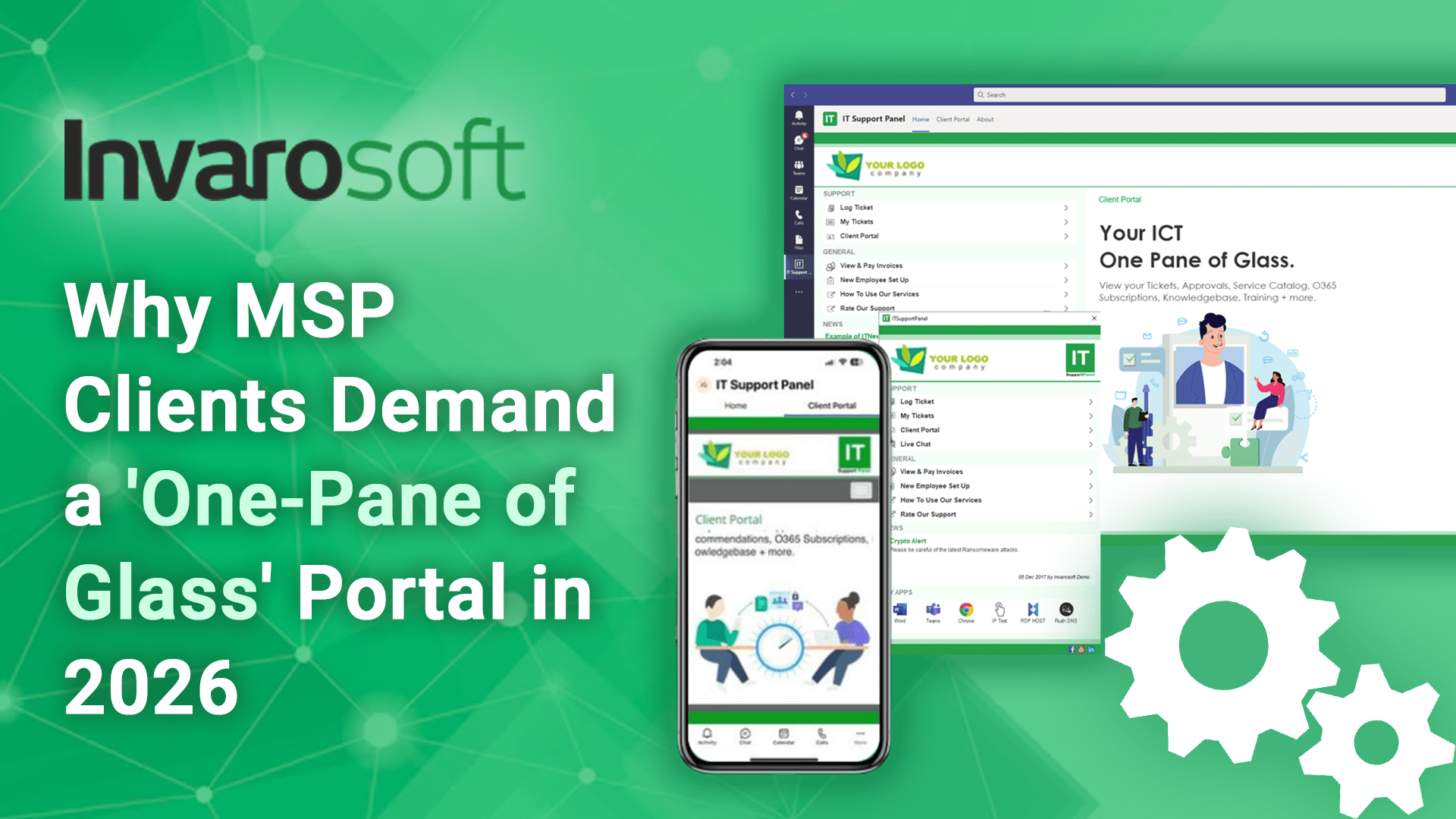
The term 'one-pane of glass' refers to a single, unified interface that lets clients see and manage every aspect of their relationship with their MSP — without toggling between multiple platforms, inboxes, or dashboards.
In practice, a true one-pane portal typically includes:
- Real-time ticket status and helpdesk visibility
- IT environment health monitoring and alerts
- Asset and device management overviews
- Billing and invoice access
- Security posture reporting (patching, endpoint protection, etc.)
- Onboarding resources, knowledge base, and training content
- Communication and escalation tools — all in one place
For the client, this means clarity. For the MSP, it means fewer reactive support calls, stronger trust, and a relationship built on transparency rather than assumption.
Why 2026 Is the Tipping Point
Several converging forces have made the one-pane portal non-negotiable this year.
Cybersecurity Accountability
With cyber threats escalating and insurance requirements tightening, SMB clients want visible proof that their MSP is protecting them. A unified security dashboard — showing patch status, endpoint health, and vulnerability reports — transforms abstract promises into tangible evidence.
Remote and Hybrid Work Normalization
Distributed teams mean IT issues can emerge anywhere, at any time. Clients want to log, track, and resolve issues without calling during business hours or waiting for an email response. Self-service and visibility are operational necessities at this point, not optional features.
Procurement Scrutiny and ROI Pressure
CFOs and business owners are scrutinizing every vendor contract. MSPs that can't clearly demonstrate value — through reporting, uptime data, or ticket-resolution metrics — are increasingly at risk at renewal time. A portal that surfaces this data automatically makes the MSP's value undeniable.
What Separates a Good Portal from a Great One
Not all client portals are created equal. The ones that drive real adoption — the ones clients actually open every day — share a few critical characteristics.
Accessibility across every device and platform. Clients work on Windows, Mac, iOS, Android, and Microsoft Teams. A portal that only works in one environment will be ignored. The best portals are available as native apps on every platform — including inside Teams, which is where many of your clients are spending their entire workday.
Designed for every user, not just the IT manager. Most portals are built for the primary IT contact. But in a 50-person business, there are 50 people who might need IT support. A one-pane portal that every staff member can use — regardless of technical sophistication — is worth orders of magnitude more than one only the IT admin touches.
Push notifications that actually reach people. Email gets ignored. Push notifications get opened. A portal with industry-leading push notification capability ensures clients see critical updates immediately, not when they happen to check their inbox.
The Utilization Problem
Here's the uncomfortable truth that most MSPs never confront: most client portals achieve less than 20% ticket utilization when competing with phone and email. That means 80% of support requests still come in the old way — defeating the entire purpose of investing in client-facing technology.
Portal utilization isn't a technology problem. It's a design and adoption problem. MSPs who simplify their support channel strategy — phone for urgent, portal for everything else — and choose a portal that clients actually find intuitive and accessible, consistently report utilization rates above 50%.
That 50%+ utilization rate translates directly to fewer inbound phone calls, lower cost to serve, and a demonstrable competitive advantage when you're pitching against rivals who can't show the same numbers.
Making the Investment Count
For MSPs evaluating their client portal strategy in 2026, the key questions to ask are:
- Is our portal available on every platform our clients actually use?
- Can every member of our clients' teams use it — not just the IT admin?
- What is our current ticket utilization rate through the portal?
- Does our portal surface real-time data that demonstrates our value automatically?
- Are we using push notifications to reach clients where they are, not where we hope they'll look?
The MSPs winning new business in 2026 aren't just offering better technology. They're offering a better experience — and a unified client portal is the most visible expression of that experience to every single person inside your client's organisation.
If your current portal isn't delivering on that promise, the gap between you and the MSPs who are is widening every day.